1. Analysis of Technical Key Points for Cantilever Formwork Fabrication and Installation
Cantilever formwork construction in municipal road and bridge projects is widely used due to its ease of operation and lightweight organizational structure. However, the cantilever formwork construction structure places higher demands on the fabrication and installation of the formwork. The key technical points are as follows:
(1) Key Points for Formwork Fabrication
Before designing the cantilever formwork, a careful check of the design drawings is required to avoid quality issues caused by design errors. The completed cantilever formwork must undergo performance testing. Only after all performance requirements have been met can the formwork be used in municipal road and bridge construction.
(2) Key Points for Formwork Installation
To ensure the safety of the cantilever formwork, installation should only begin after all materials and processing equipment are ready. The current mainstream cantilever formwork installation process is as follows:
(3) Safety Protection During Formwork Installation
1) Safety of the Formwork Itself: The safety of the formwork during installation is directly influenced by the installation frame. After completing the basic framework construction, it must be thoroughly inspected. Only after confirming that it meets the required load-bearing capacity and reliability can the formwork installation proceed.
2) Safety Threats to the Surrounding Environment: During installation, the surrounding area must be cleared to ensure no unrelated personnel are present. This prevents accidents where falling objects from the installation process could injure workers.
2. Analysis of Pre-Pressing Test Key Points After Formwork Installation.jpg "中铁十八局包银7标磴口黄河大桥_3061吨_(3).jpg")
(1) Key Points for Pre-Pressing Preparation
Before carrying out the pre-pressing operation, the rear anchoring system of the formwork must be securely fixed. The main components to be fixed are the front beam and the rear pressing system. The usual method for this is anchoring, which ensures the front beam and rear pressing system rods are subjected to evenly distributed forces. These systems are essential for the safe operation of the cantilever formwork. Uneven forces between these two systems can lead to instability, tilting, and other serious safety issues during operation, which would not only affect construction quality and efficiency but also endanger the safety of workers.
(2) Key Points During the Pre-Pressing Process
The pre-pressing process is a critical step in testing the installation performance of the formwork. This process should be subdivided into multiple levels based on the actual load-bearing capacity of the cantilever formwork and the time limits for pre-pressing activities. Typically, the higher the load-bearing capacity of the formwork (e.g., 10 tons or more), the more levels are required. During the pre-pressing process, equal weight should be applied to both sides of the formwork.
3. Analysis of Concrete Pouring and Prestressing Technology Key Points
(1) Key Points for Concrete Pouring
Once the formwork is in position, the bottom mold is used to support the transverse and longitudinal beams of the cantilever formwork. Since each beam segment requires constant height adjustments, there is no need to form a complete structure between the inner mold and the framework. Instead, the final pouring method should be determined according to the specific section of the box beam. During the pouring process, holes should be reserved in the center of the top slab to ensure the concrete flows into the box beam evenly. When the box beam is high, concrete transportation should be facilitated using a deceleration funnel. During secondary pouring, the specific completion status of the bottom mold, side mold, and steel reinforcement should be taken into account.
(2) Key Points for Prestressing
When the concrete specimen reaches 80% of its design strength (48 MPa), the end and side molds are removed, and prestressing is applied. The prestressing process follows a dual control principle to ensure that both the stress and elongation meet the design requirements. After prestressing, the ducts should be cleaned, and grouting should be carried out. Strict control of the technical indicators of the grout is required to ensure that the grouting pressure is maintained for 5 minutes. The grout holes should then be sealed with wooden plugs.
4. Analysis of Cantilever Formwork Travel Key Points
The cantilever formwork travel process is crucial for moving the formwork to the next casting position. The key technical points for this process are:
1) Use a hydraulic jack to release the stay cables, and employ a chain hoist to fix the front supporting beam and side mold to the cast beam body, then remove the stay cables.
2) Remove the rear suspension rods of the inner and outer sliding beams, and release other constraints on the main beam. A pressure wheel can be used to replace the pressure device.
3) Use a chain hoist to move the main beam system along with the sliding beams to the designated position of the next casting section, and anchor the main beam system to the cast beam body. Connect the inner and outer sliding beams to the rear beam.
4) Release the constraints of the bottom formwork and side mold on the beam body. Move the bottom formwork and side mold to the outer sliding beam, and then release their constraints. Using the outer sliding beam and chain hoist, move the formwork to the designated position.
5) Install the stay cables and lower rear anchor cables, adjust the mold, set limit anchors, and tie the bottom and web reinforcement.
5. Analysis of Closure Construction Key Points
Closure construction is an essential part of municipal road and bridge projects. The success of the closure has a significant impact on the overall quality and future performance of the bridge. Therefore, before closure construction, a thorough analysis of the construction environment, materials, temperature, and other factors that may influence the closure process is necessary. A suitable closure method should be selected, and corresponding mechanical calculations should be made. After locking the closure joint, the closure work should proceed quickly:
1) First, effectively connect or weld the rigid support section at the closure joint to the embedded parts at the bridge's beam end.
2) Then, connect the other end of the external rigid support to the beam, and quickly tension the temporary prestress strands.
Conclusion
In conclusion, cantilever formwork construction is commonly used in municipal road and bridge projects due to its ease of operation and lightweight structure. However, because the formwork is often suspended at high altitudes and the structure itself is complex, it is crucial to strengthen the analysis of its technical key points and quality control processes. By ensuring proper design, installation, testing, and construction practices, the safety and quality of the bridge can be ensured.






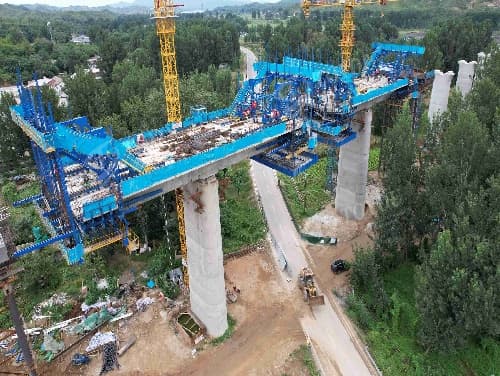
.jpg "Continuous Beam over G338 National Highway in Tianjin-Weifang High-Speed Railway Package4")
.jpg "Yongzhou Road Continuous Beam of the Access Railroad for Henan International Logistics Hub")
.jpg "Dengkou Yellow River Bridge of the Baotou-Yinchuan High-speed Railway Project")
.jpg "Standardized hanging basket")


 Consult
 Message
