




 Home/
News/
Project News/
Quality Control Measures for Cast-in-Place Box Girder Construction in Road and Bridge Engineering
Home/
News/
Project News/
Quality Control Measures for Cast-in-Place Box Girder Construction in Road and Bridge Engineering
Quality Control Measures for Cast-in-Place Box Girder Construction in Road and Bridge Engineering
Warm Tip: If you want to know more information, like quotation, products, cases, etc., please Click here, and contact us online.
In road and bridge projects, cast-in-place construction is currently the primary technology for box girder structures, which are composed of steel box girders and reinforced concrete box girders with stable structures. This article focuses on the quality control measures for cast-in-place box girder construction in road and bridge projects. 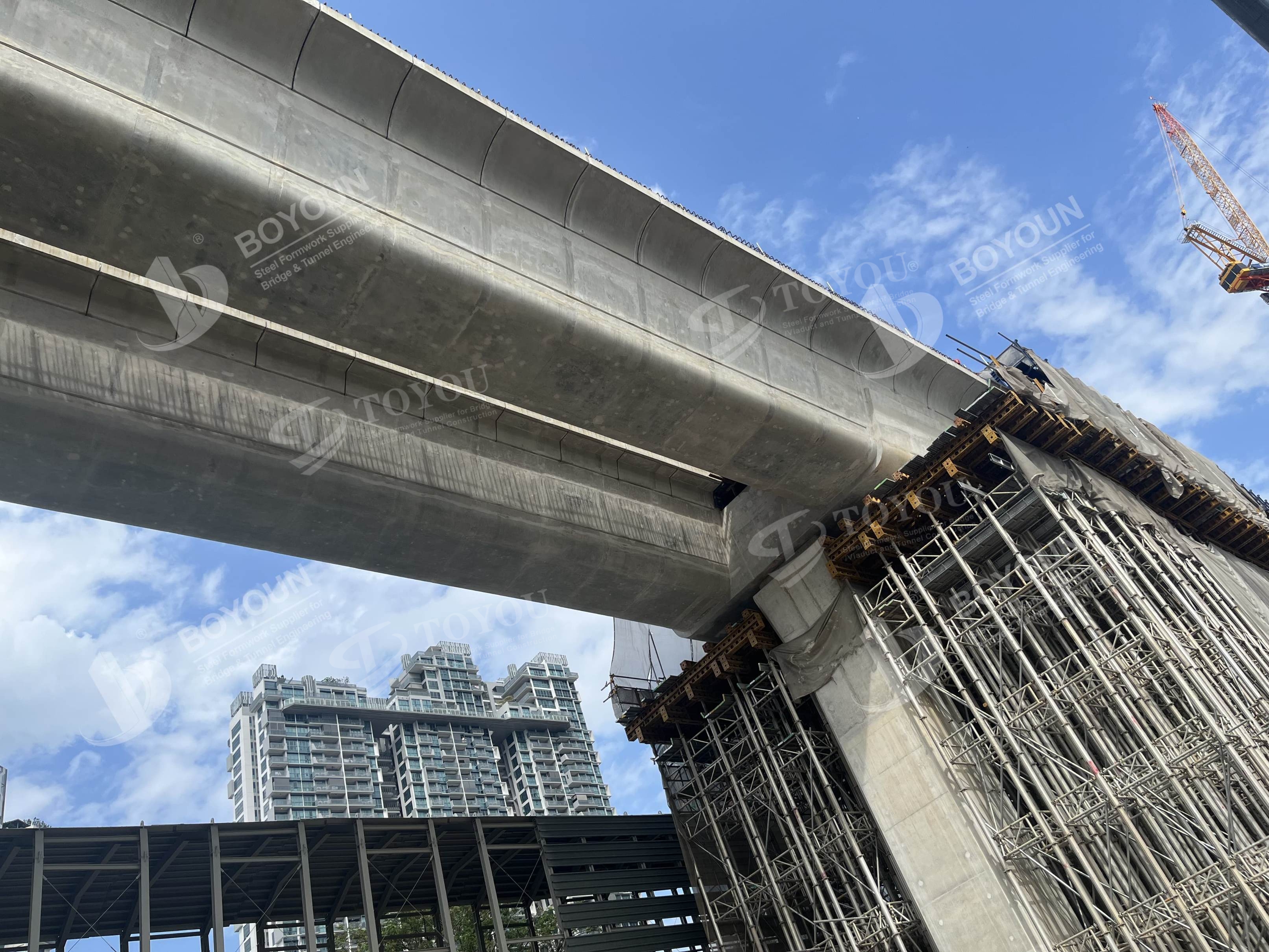
Currently, cast-in-place box girders exhibit strong adaptability to engineering environments and can be successfully constructed in various settings. By adjusting bridge spans or changing the curvature of planar curves, and flexibly modifying the operation parameters of cast-in-place girders, cast-in-place box girders can be successfully built. Due to their high adaptability, they effectively overcome topographical limitations in projects.
Cast-in-place box girder construction technology is applied in road and bridge projects, primarily through construction on bridge box frames. As a result, the construction area is relatively small, avoiding excessive occupation of the site and facilitating the smooth progress of road and bridge construction. It can be seen that the current cast-in-place box girder structure design offers strong applicability and a small construction footprint, benefiting bridge alignment design and construction.
Meanwhile, due to the large span capability of cast-in-place box girder technology, it can effectively handle ground obstacles when constructing curved bridges, demonstrating strong adaptability to external conditions. The construction of cast-in-place box girders typically adopts one-time continuous casting design, which improves the utilization rate and load-bearing capacity of road and bridges, providing better service for people's travel. Additionally, construction can be carried out directly above pier columns, resulting in a lighter bottom structure with a more aesthetic appearance. This also reduces project costs and enables rational and effective use of road and bridge construction funds.
1. Protection of Inner Formwork for Girder Top to Prevent Detachment and Damage
The inner formwork of the cast-in-place girder top must be complete and stable; otherwise, it will affect the bridge's construction quality. The inner formwork of the girder top must not be damaged or discarded before the cast-in-place box girder concrete is fully formed. To avoid this issue, the inner formwork of the cast-in-place box girder top is typically fixed with rivets to ensure stable installation. During subsequent operations, workers strictly follow specifications, pay attention to the rational use of construction methods, and effectively improve work standardization to ensure the quality of the project from the source, preventing abnormal damage to the inner formwork of the box girder top. Ensuring the stability and reliability of the inner formwork of the girder top helps improve concrete forming effects and lays a good foundation for future construction.
2. Inspection of Hoisting Equipment Before Formwork Hoisting
Before hoisting the formwork, inspect the equipment, adjust the crane's position, and carefully check the hooks. If no issues are found, hook the formwork, remove the temporary supports, and then have professional personnel complete the lifting work smoothly. During formwork installation, precisely control the formwork position and connect adjacent formworks tightly. When installing the external formwork of the side walls on-site, appropriately use tension screws to improve the formwork's stability.
3. Control of Concrete Materials During Pouring Construction
Concrete is a critical material in pouring construction, consisting of cement, coarse aggregates, water, additives, etc. As the main raw materials, different materials are selected according to specific ratios, and a highly uniform mixture is obtained after thorough mixing. If quality control is qualified, the mixture should be immediately used for pouring to minimize the time between mixing and pouring. In special cases, if the initial setting time of the concrete exceeds the specified time, this portion of the concrete is deemed worthless and treated as waste, requiring removal and re-pouring.
4. Conclusion
In summary, cast-in-place box girder construction technology is currently widely used in road and bridge engineering, with obvious advantages in application. However, to further optimize construction effects, technicians often need to continuously improve existing construction techniques. Reasonable application of cast-in-place girder technology in road and bridge construction helps ensure the overall project quality and the smooth completion of construction tasks. During construction, enterprises must standardize the application of existing cast-in-place box girder construction techniques and processes. Construction personnel must accurately control construction key points, follow the design plan for rational construction, and comprehensively improve the construction quality of road and bridge projects.
Prev: It is already the first case.
.jpg "Continuous Beam over G338 National Highway in Tianjin-Weifang High-Speed Railway Package4")
.webp "Ranmuduo Mega Bridge Cantilever Carriage Project")
至天水高速公路渭河特大桥 653吨 (5).jpg "Weihe River Bridge Form Traveler Project")
.jpg "Great Wall-Crossing Mega Bridge of the Yinchuan-Bayanhot Railway")
.jpg "Standardized hanging basket")


 Consult
 Message
